Step forward, step back

Teams that don’t gridlock each other have learned a couple of important steps. If we consider our examples of:
…when they come to understand that they can leverage one another, they can harness each other’s skill sets.
This is what we mean by “step forward, step back”. Bruce is not always the best person to peak on everything, and he needs to learn how to make space for Brad, for example.
Here are some other pointers for making teams more effective.
1. Leverage different time orientations
Some people are more future-orientated, some are more present-orientated, and some are more past-orientated.
Allowing some people to think ahead about the issue, while others process those insights in the moment, and then allowing past-focused people to come back with reflections, will give a much more well-rounded perspective for the team.
2. Don’t play people out of position
If you send an operational person to a three-day strategy session, they’ll probably feel like they’re going to go mad.
Similarly, if you let strategic people loose in process-orientated conversations, they are likely to make a hash of things.
Process people need to understand that, left unchecked, they will likely over-engineer processes, bringing things to a halt.
So, it’s about using the right skill set at the right time.
3. Get the order of skills right
There is a sequence to the kinds of leadership skill sets required on a project or during a business lifecycle. A lot of the time, visionaries bring in operators to help them get things done and only later realise the need for process in what they’re doing.
Furthermore, as projects are operationalised, the people who are doing the work are not the ones who created the product or service.
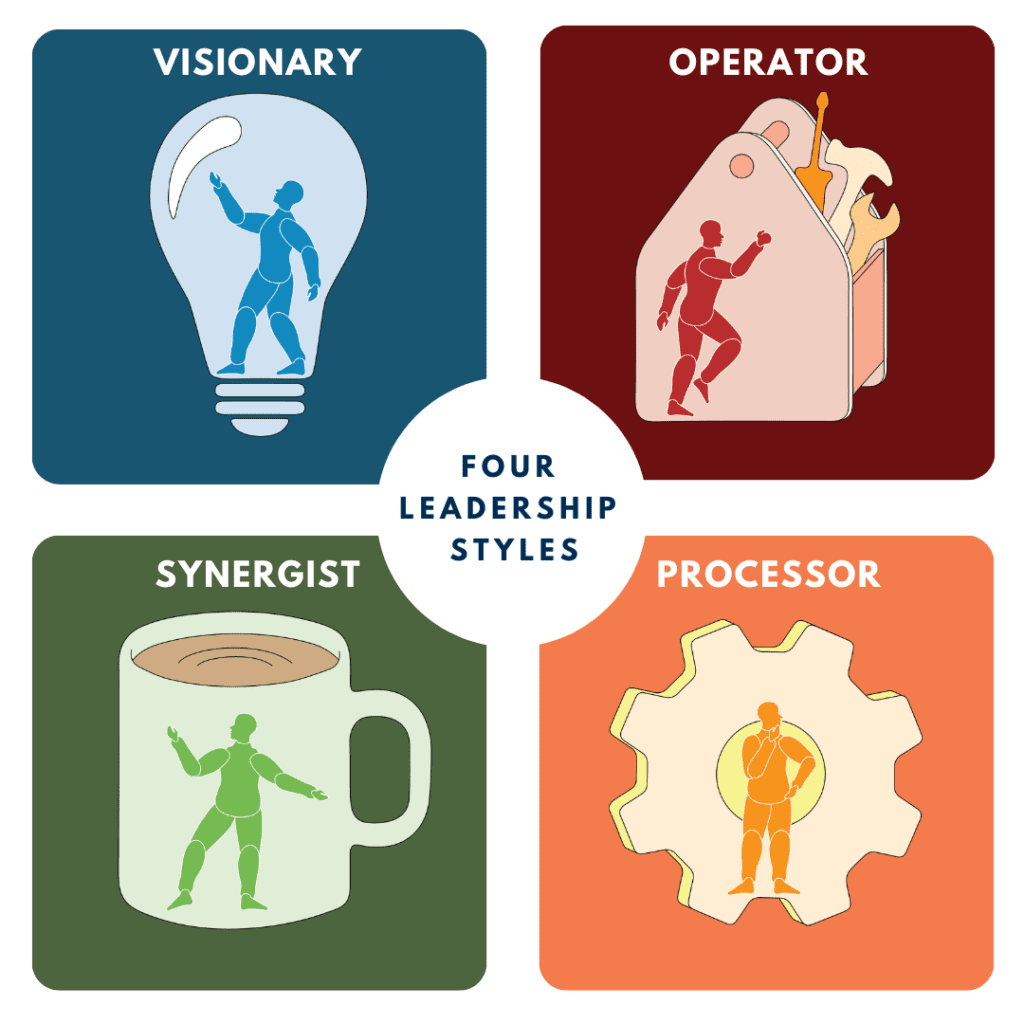
This is when the skill set of synergists is needed, both for how people are communicated with and for how the theory plays out in practice.
There is also the realisation that the order of skill sets needs to change. Instead of visionary, operator, processor and synergist, the skill order should be visionary, processor, operator and then synergist.
This results in a flow where the energy of the visionaries goes first into an analysis phase with processors before moving into operations.