Portfolio alignment

Portfolio alignment is about connecting what teams are doing on the ground with what is being decided in Exco. It is one of the trickiest things to get right within a business.
Typically, boardroom strategy is disseminated into large programmes within the business, which are then broken down into projects, then into teams, and lastly into the work individuals do on a daily basis.
The challenge for most Excos is that, while the strategy aims to define the roadmap for the business, they often only have lag measures available to determine whether the company is on track. The reporting and visualisation of goals, together with the alignment of departments and teams around those goals, is where the real complexity lies. The more steps there are between Exco and the individual working in a team, the more opportunity there is for misalignment.
Models like the Scaled Agile Framework and tools like Product Increments which allow programmes to be broken up into three-month cycles. If the tooling is correctly set up, the business can layer its hierarchy of activity in the following way:
1. Strategic Objective
– The “why” at portfolio level (e.g. Increase customer retention to 90%).
2. Portfolio Initiative
– Large investments tied to a strategic objective.
– Often cross-team and cross-product (e.g. Customer Loyalty Modernisation).
3. Project / Capability Group
– A coherent body of work under an initiative (e.g. New Rewards Engine).
– Use “Project” if your organisation is project-oriented; “Capability” if it is more product/BAU-oriented.
4. Deliverable / Capability
– Something tangible the business can use (e.g. Tiered Points Rules Engine, Customer Rewards Dashboard).
5. Work Item / Activity
– The actual work people do to build the deliverables.
6. Sub-activity / Step
– Smaller units or checklist items within an activity.
In our tooling example, we show how this can be layered.
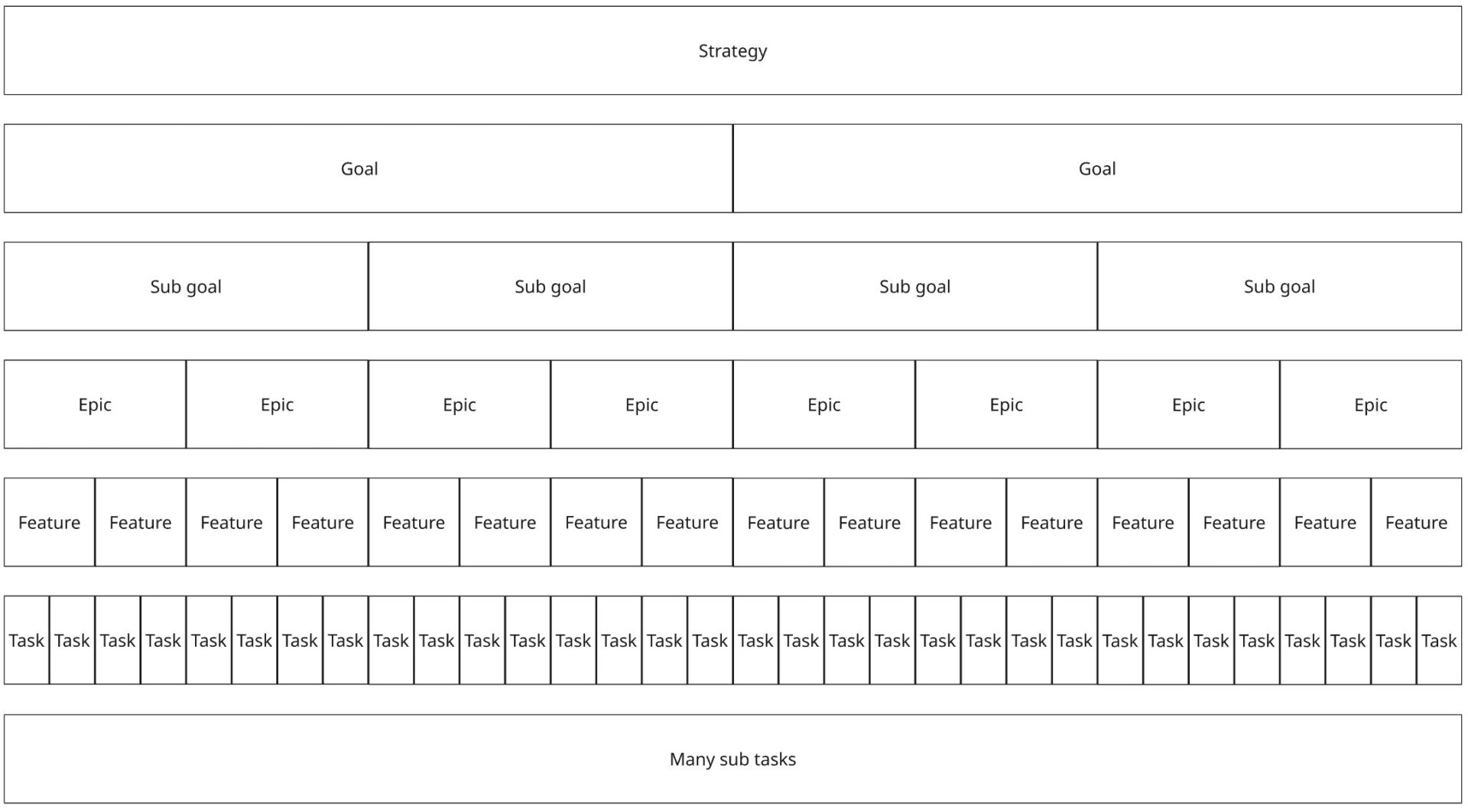
This allows Exco to move from relying only on lag measures to using lead measures as well. They can implement real-time reporting from the tooling, which will roll up into a live scoreboard showing how the strategy is progressing. This will either give them the information they are looking for or highlight that something is out of sync in the business workflow, thereby creating a cadence of accountability.
Executives can then drill down into areas of misalignment and unblock the things that are preventing teams on the ground from aligning with the strategy.
Once the framework is established and operating across the organisation, the business can then cycle through a process of:
– Planning
– Launching a product or service
– Driving uptake
– Optimising the product or service
– Habitualising the go-to-market process within the organisation
Th1nk helps executives with the process of setting up portfolio management and optimising it within the organisation.