Leadership styles
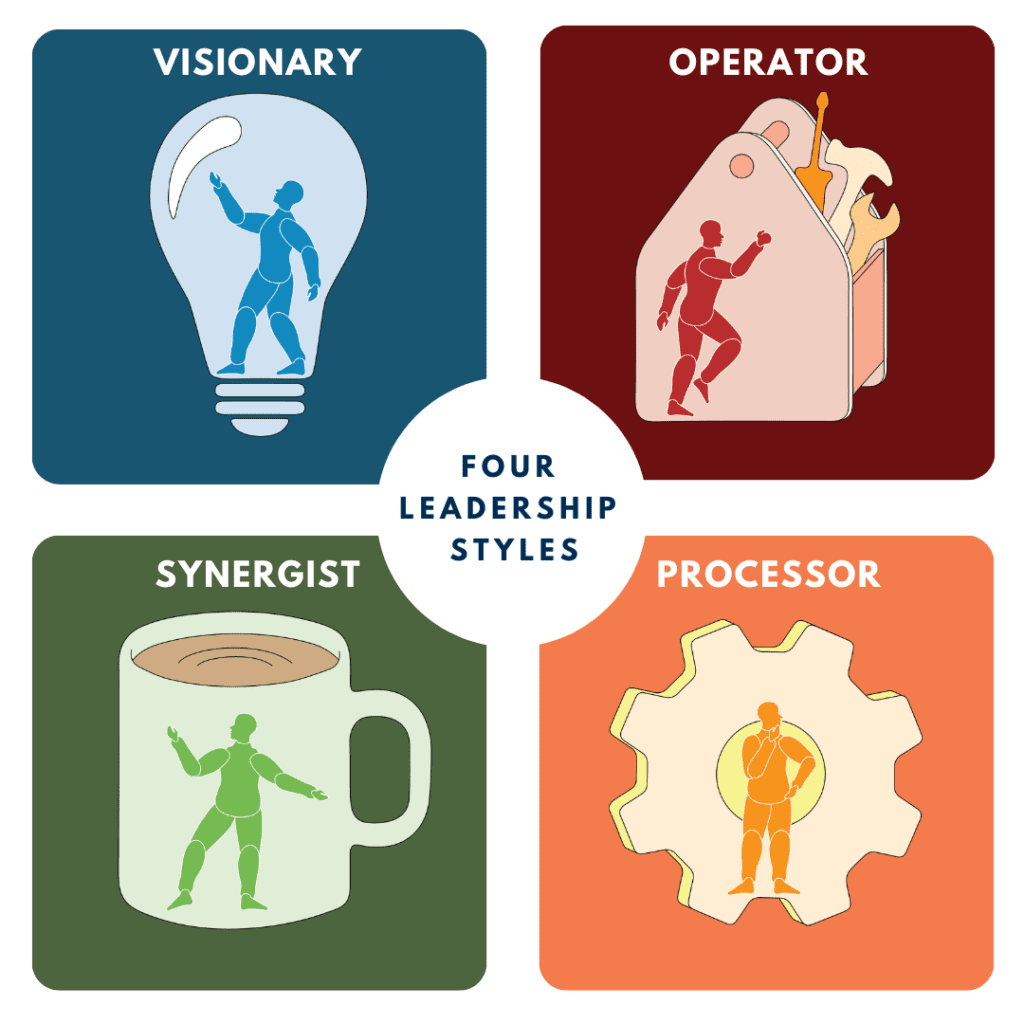
The style of leadership a person has can often be best understood in relation to the phase of an organisation’s growth.
For example, organisations are often started by visionary leaders who have a great idea, and who then bring in people with an operator or hustler style to put their ideas into action.
As the organisation grows, it begins to face complexity challenges that arise from scaling. At this point, it needs to bring in more process-oriented people, who smooth out the complexity with repeatable processes that help the organisation to scale again.
This gives rise to functions such as finance, human resources and customer service. As more people are onboarded into these divisions, there is also a growing need for employees with strong soft skills — people who can align teams and help them work better together. These individuals are often referred to as synergists.
Leadership styles can also be viewed through the lens of how leaders use power — whether they exert power over people, give power to people, or exercise power alongside others. This could be framed as playing not to lose (power over) versus playing to win (power to and power alongside).
Another useful lens is relational and task maturity, which considers how mature leaders are in both the work they do and the relationships they build.
What becomes important for leaders — and, in fact, for anyone in the workplace — is knowing when to step forward and lead, and when to step back and allow others who are better suited to step forward and take the lead. This is true self-awareness in leadership.
Through this approach, Th1nk helps organisations to leverage the combined skill sets within the organisation, enabling it to become far more effective and resilient.